Monday, June 3, 2019

What, exactly, am I doing?

This is a quick guide to what I’m doing in Ireland for family and friends who aren’t familiar with academia and/or medieval history. I’ve tried to make it as accessible as possible but of course will continue to answer questions if anything remains unclear. 

I am a PhD student at Trinity College Dublin. A PhD or ‘doctorate of philosophy’ is a degree, like a BA ‘Bachelors of Arts’ or MS ‘Masters of Science’, but it is a terminal degree and a research degree. ‘Terminal’ means that it’s the top degree - there’s nothing more after it, educationally speaking. And ‘research’ is the big difference between the PhD and other degrees. 

While I have a few additional requirements which I’ll write about below, the main thing that I am doing as a PhD student is writing a ‘thesis’ (‘dissertation’ in the US). The thesis is a roughly 100,000-word document - the size of a small book - that is my own original research. It has chapters, each with their own smaller ideas; mine’s looking like it will be six total. 

The pace of my work varies between collecting the information, analysing it (making my own interpretation of what it means), writing out what I’ve found, and then editing so it all reads nicely. I do different sections at different times and sometimes what I find in another section will change what I think about what I’ve already written, so there is a lot of back-and-forth work. I can’t simply write 400 words a day and be done with it in a year because there is a lot of information to wrangle into a very long, multi-part argument. It has to convince the top experts in my field, so it has to be as good as possible.

As a result, it’s hard to say exactly how I am doing and whether I am succeeding or not. I’ve been asked if I’m ‘passing my classes’ which is not really a thing at this point in my education. I have taken some language classes, and I’ve also done a course on reading the way manuscripts are written, but I don’t take exams or are required to ‘pass’ these classes in order to continue. 

The way I am evaluated is by the professor in charge of my thesis, my supervisor (‘advisor’ in the US). Mine is Seán Duffy. He’s been at Trinity for several decades and is a brilliant historian, but what I really like about him is that he is very involved in public outreach - everyone in Dublin knows him. He is also married to an archaeologist with her own amazing career and they have a teenaged daughter, so he understands my needs as a student with a family. Seán and I meet every two weeks to discuss what work I’ve done and what I should do next. Once a year, other Trinity professors also read my work and add their own remarks. Together, they decide if I’m making sufficient progress for me to continue. So far, so good!

If I don’t hit any problems then I will be submitting my completed thesis in September 2021. Whether it is accepted is determined by an event called a viva (pronounced ‘VIE-vah’, and called a ‘defense’ in the US). This will happen a few months after submission, so probably between November ’21 and February ’22. My supervisor and another Trinity professor, called an ‘internal’, are on the committee who reads my thesis and decide if it’s good enough to pass. The final member on the committee is called the ‘external’ and they’re the Simon Cowell of the trio. They’re a professor from another university, and at Trinity that often means flying someone over from the UK or even further. The external has no reason to pass me and every reason to say that my work isn’t good enough, so they’re the one to impress. If all three professors agree, then I’m a doctor! Most of the time though they give ‘pass with revisions’ and that means while it’s good enough, there are still a few small things that need more work before its officially published. 

Now, my field is small enough that I can guess who my external could be, and it’s almost certain that I’ve met them before. I’m also using this time as a PhD student to go to events and meet people. Reputation is very important in academia, especially the very specific areas that I work in like ‘twelfth century Irish history’ or ‘Middle Irish language’. The more people see my face and hear me speak about my work, the more they’ll remember me when it comes time for jobs or funded projects. It’s also good for me to get to know people who may be my boss or colleague in the future - and those who I’d rather not work with! 

Finally, being able to chat with experts means I’m on the cutting edge of new ideas in my field, even further than scholarship, which takes a few years to publish. If I have an idea that I think is brand new, but I find out that someone’s already written it and it hasn’t come out in a book yet, then I can skip that idea or wait until I can read the book myself. These things happen. I wrote a chapter on something never before written and then, a day after discussing it with Seán, heard another Trinity scholar give a paper with a lot of the same information. On the one hand it was nice to know that he and I made the same conclusions, but on the other, his work is now already out there and I have to acknowledge and build on what he’s said. 

So, what am I writing about? I’m using three Irish stories written between the years 1030 and 1130 to determine current ideas and opinions. These stories are about heroes who fight Vikings in Ireland in the 8th, 9th, and 10th centuries. But I think that they are really about the descendants of the Vikings in Ireland, the Hiberno-Norse, who were very powerful in Ireland but still distinct from the rest of the Irish. Dublin, Limerick, Waterford and Cork were all Hiberno-Norse port towns, while the rest of the country had few centralised populations or ocean-going ships. So I think that these Irish stories about the Vikings are actually more about the Hiberno-Norse. This is just like how Arthur Miller’s play The Crucible was about the 17th century Salem witchcraft trials, but it was really about McCarthyism which was going on when he wrote it. 

The documents I’m analysing are in Middle Irish, which was used and written from the 800s to 1200. Irish language is as different from English as Russian or Italian, so I’ve got to work through it being foreign as well as it being old. Middle Irish is different from modern Irish, but they share a lot of grammar and vocabulary, so I keep up studying and using modern Irish to get more familiar with the older form of the language. I’m also reading other documents from the time period for context, and some of these are partially or wholly in Latin, so having taken it in high school is still coming in handy!

My three main sources are available in ‘editions’ which are modern write-ups of the original manuscripts’ text and an English translation. One was done in 1974, another in 1905, and the third in 1857! So this means I have something that is translated and transcribed from the manuscripts to guide me, but the older editions are misleading and obviously missing over a century of work on Middle Irish language and history. I will need to look at the actual medieval manuscripts in archives to check the editors’ work. But since the manuscripts are very fragile and priceless, I’m waiting until I’m more certain about what I will be looking at before going into the archives. The great majority are in Dublin, another reason why I’m there; but there are few in Oxford, England and one important one in Brussels, Belgium. 

Therefore, it’s hard to say what a typical day looks like for me. Ideally I spend most of the time that Arthur is in school writing and editing what I’ve already written. I teach for the university and ‘invigilate’ (administer/proctor) exams so that takes some time too. I have a mountain of scholarship to read, not just for my thesis, but because I’m training as a medieval historian and I have to be on top of current ideas about the Middle Ages as a whole. There are lots of events such as one-off lectures and workshops and I go to as many as I can during the weekdays, because evening events require childcare. Even with Arthur, being in Dublin makes this far more possible because there are two big universities and several research centers in town, so there’s always something going on. 

I have a desk in my apartment and quite a lot of work gets done at the living room table facing Arthur’s play area, but my main base of operations is the Medieval History Research Centre. Simply called ‘the office’ by those of us who use it, it is a 500+ sq ft room that houses a library of several thousand volumes and full size desks. There are two big windows and a fridge, microwave, and kettle. The office is the back of the second floor of a Georgian-style building circa 1750. There’s a keypad lock on the door, and the building has a security guard on the weekdays and is only keycard accessible on the weekends, so we can leave valuables there safely. 

Some people only use it occasionally so they utilise an open desk, but there are a dozen of us who are in there every day and have their own established space. I recently commandeered the in-demand desk in a nook next to the window when I happened to catch the leaving PhD moving out! I’ve got drawings by Arthur and postcards from the national museum up, leave my shawl and teas there, and so on; it’s quite comfortable. I’m usually the first one in the morning around 8, but by noon there will be four or five people there, and when I go home around 4 it’s a full office. 


So, hopefully you have a better idea as to what my life is like in Dublin. I work hard on the weekdays so that I can hang out with Arthur in the evenings and all weekend, but sometimes deadlines press or emergencies pop up and I have to do as best I can. By making my own schedule, it’s the ultimate in flexibility, but it also means I have to be very careful to work diligently and regularly. I know I’m making the absolute most of my time in Ireland and at Trinity, and I appreciate your support as I continue on this journey.

Sunday, March 10, 2019

Academic parenthood

Written at 6:45am on a Sunday morning during a Dora the Explorer marathon, gods help us all.
----------

Last summer I wrote about being a heathen and a mother in the first essay published on this version of An Currach. I found the exercise tremendously helpful for collecting my own thoughts, and many other people found resonance and wisdom in my writing. Since mid-October I have functioned as a solo parent and PhD student an ocean away from the rest of my family. The time has come to try to collate my experiences here and see if I can build that same bridge to other peoples' understanding.

First, an introduction to my specific circumstances for context. I have a son born May '15, 'Skyforger', so at the time of this writing he is three going on four years old. I am in the second year of a four-year research PhD in Ireland while my family all live in New Jersey, and as my husband has an immobile (albeit successful!) career, we've had to split our household during my degree work. I'm able to support my household here on an IRC scholarship and government student loans, and my husband visits as often as possible.

Skyforger is in the eldest class of the on-campus crèche (daycare) and will be starting school in Ireland this September. While I only teach a few tutorials and have a single mandatory weekly lecture, I require hours every day for research and writing, and I also need to attend and occasionally participate in conferences, symposia, and other academic events. I have a regular childminder as well as a flatmate who can watch Skyforger during events and emergencies outside of daycare hours, but there's no one here who is 'obligated' or invested in watching him; no dropping him off at the grandparents' for the night, for instance.

I gave birth to Skyforger when I was 28 years old. There are American women intentionally bearing their first children at 18 years old, and others at 38 years old; I thought I'd be smack dab in the middle of fellow mothers at my maternal age. (And I struggled with sub-fertility for several years first.) I didn't realise how much the average age at first birth skewed upwards for academic women. I may as well have given birth as a teenager for how unusual I am to have a child as a PhD student.

I knew I'd be slightly out of kilter with my cohort, starting my degree in my 30s. Being a foreign student as well doesn't help, but I've done it before, and at least I speak the languages. Having a child, though, means I may as well have beamed down from Alpha Centauri as far as shared experiences with my colleagues go. I only exist between 8:00am and 5:00pm every weekday, when I not only have to do all of my writing and heavy reading, but also everything else that is nigh-impossible with a preschooler on hand: grocery shopping, exercise, house cleaning, and so on.

I am a morning person, at least, but I had to buy a bedside clock to show my son how we can't get out of bed before 6:00am. I hit the ground running getting breakfast into and clothes onto Skyforger, then bringing (often carrying) him to campus a kilometre away for his crèche. Then back to the flat for my computer, lunch, and whatever reading I brought home in a futile attempt to stay on top of my work during the evening; and a return to the campus office. (That's 3km by 9:00am most days.)

I use an iCalendar shared with my husband to keep track of my larger schedule, and a complicated paper planner to chart out each day's priorities and record my time usage to the half-hour. Rather than get mired in the minutia, it'll be suffice to say that by the time Skyforger goes to sleep around 8:00pm and I've cleaned up his dinner and bath toys, I rarely stay awake to 9:00pm myself. He'll crawl into my bed around 2:00am, ask for the toilet or sing himself to sleep again, and most nights instead of my falling asleep again right away, I spend an hour or two staring at the ceiling running over everything that still has to be done. Then around 5:30am I'll be begging him to read the clock and wait until it reads 6:00. Every day. Even weekends.

No nights off. No sleeping in. Ever.

And because of this... I have no pity for my colleagues. It stinks. I don't mean to be cruel, but sometimes I don't have the energy to keep smiling.

Insomnia happens. Inability to fall asleep at a decent time happens, and difficulty getting out of bed and getting the day started happens. Executive function disorder happens. But I can't empathise, and most days I can't sympathise either. You were out late and you missed a morning's work? That's a shame. You wasted your entire weekend watching Netflix? How unfortunate. You went out drinking and now you have a hangover? That really sucks. But don't fucking complain to me, please. It's not going to end well for either of us.

Student-parent problems are so low-level yet widespread that few people even notice that they exist. Children aren't allowed in the libraries, for instance, not even over the threshold. This means that when a ILL or stack request comes in and I have 48 hours to retrieve it from notification, if it comes in on Friday afternoon, I have to ask someone to watch my child for thirty seconds so I can walk 10 metres into the library and get it.

My department has mandatory lectures on Thursday evenings, followed by an optional but oft-attended trip to the pub afterwards. I have a standing childminding session for this, as one night a week out is for everyone's benefit. But when my colleagues don't want to go out after the lecture because they want to stay in and study, or they've been out too many times that week already, I want to cry. 'This is my only outlet! Please stay!'

I was accepted for a Friday-Saturday conference at my institution. Hooray! So I requested that I speak on Friday so I don't have to book a childminder. Granted, thanks! And then I remember that I've already got all my tutorials lined up on Fridays so I only have one day to worry about finding care for Skyforger if he's out of crèche for whatever reason. Back to another email! The conference organisers have been wonderful, thank goodness, but this is the over-engineering, constantly-planning stuff perpetually spinning around in my brain and affecting my ability to function.

I go to every weekday day-time lecture that I possibly can, and if I hear about an important evening lecture I make plans to attend. But even being on multiple mailing lists and social media announcement groups, I often hear about exciting opportunities with less than a week's notice. Forget about things going on in other cities, or the UK/continent. It wouldn't be so bad if I didn't keep running into this door over and over again.

'Oh, you have to attend this symposium in Edinburgh.'
'Will there be childcare?'

'Come to our new lecture series! We've got this and that and this -'
'When is it?'
'Evenings at -'
'Can't afford another night of childminding.'

'Did you see the Anglo-Saxon exhibit in London?'
'I would have loved to go, but I couldn't spare the time or expense.'
'Flights to London and hostels are cheap if you don't mind traveling! It's easy to get around the city.'
'Not when there's a three-year-old involved...'

And that's academic stuff. I get to have versions of these conversations over and over again with Irish language events, metal shows, pagan meetings... It's a heavy mental toll. It fucking adds up.

And even when people try to be accommodating, they have no idea. For instance, there's a family friendly trad sesh going on at Trinity next week. Awesome! It starts at 7:00pm, which is when Skyforger needs to start brushing his teeth and getting ready for bed. Damn.

I can play this four-dimensional chess game with my son's and my life. I've done it and I'm going to continue to do it successfully. I work on everything that I can as soon as I can because either of us getting sick derails everything, and as you can imagine this happens often in a damp city in winter. I try to sympathise when my son misses his father or is frustrated by his schedule, and I leave weekends open for us to do whatever matches the weather and our energy levels.

But I'm at 100% capacity, all the time, and I cannot give any more. The student society I helped to set up suffers because I can't give it the attention it needs, my offline friendships are wilting, and I've got genuine FOMO (Fear Of Missing Out) hitting me every hour of the day. This is mostly during these early mornings when I'm online seeing photos of everyone's last night.

I try to justify this to myself that some of my colleagues are going to become parents, and then they'll 'get it'. But many will never become parents (which is fine!) and very few will do so in a precarious employment situation with their partner an ocean away. What really gets me is when other postgraduate students, particularly straight men, casually mention that they'll become parents in a few years, like it's that easy to slip a kid or two into their careers.

I genuinely hope that any of my cohort who wants children has them at their convenience and never has to deal with the multi-limbed plate-spinning that I do. And I console myself that, if there's a time of life to have too much going on, it's when I'm in my early thirties and excellent health. This will definitely pay off in two decades when I have an amazing career and a young adult son that I don't have to worry about. Right?

Right...?

Sunday, February 24, 2019

Imposter syndrome, academia, and heathenry

I intended for this blog to be a semi-professional venue for my work in both academia and heathenry, putting out essays on various topics once a month. I missed January and I'm about to miss February, for similar reasons, so I thought I would try something new. Something is better than nothing and, as I'm finding on social media, honesty about the process is scary but important.

Two very important things happened at the end of January and beginning of February. The later one was that I gave a forty-minute presentation to my department that was received very well. It was my treatment of one source in the manner in which my entire thesis is structured, and my success is valuable affirmation that my work is comprehensible. I won't publish anything from that here yet because I hope to present pieces of it at ICM in Cork in June and the ICCS in Bangor in July.

The other important thing was that the kindred I helped to found, Kindred of Mann, has reached its tenth anniversary! It is hard to believe that something which my now-husband and I sort of threw together when I was twenty-one years old is now in its second decade. I meant to write about this in January (the official anniversary is the 24th). But as often happens, I felt blocked about being boastful in public, as if stating the fact that our kindred is ten years old is arrogance. Who cares? Who am I? What kind of accomplishment is one that I can achieve?

Concurrently, over the past few weeks I've been chewing on the concept of imposter syndrome ('IS'). I had something of IS during my masters programme at the University of Connecticut and then a much worse version of it during my first PhD programme in art history at Temple University. In both cases I felt like I had to always be 'on' and perform impeccably, which was very hard to navigate as someone whose parents never went to university, let alone graduate school.

I operated on the edge of being 'discovered' because, frankly, I was trial-and-erroring my academic career. I didn't even know what a salary was until I was in a Masters programme (you can get paid for just...having a position? Your work matters, not the hours put in? What sorcery is this!?). So forget about understanding what postdocs are, how tenure works, what conferences are for, or how to publish an article in a peer-reviewed journal.

This third round in the graduate sphere has intentionally been low-performance, high-production. I don't wear nice clothing or makeup unless I'm presenting, and I don't hide tattoos or piercings any more. Instead, I put in the hours writing, applying for things, and politely but forwardly networking at lectures and academic events. I don't pretend I'm the next great scholar or will ever be a full professor. I'm just a mature student here for a PhD and enough jobs to string together into a career. I'm not faking anything, so there's nothing to be exposed. I can't have IS, or so I thought.

IS, I have found, is also a chronic under-evaluation of the self and one's achievements. It's a Tetris board in my head: mistakes pile up, while successes disappear. I struggle to fit my qualifications into a one- or two-page CV, but when I look at them laid out like that, it seems like another person's work. How did I ever get all that done? Who did I trick into winning that award or giving that paid lecture? Yet I still acutely feel failures from previous graduate work... undergraduate... even high school rattling around in my chest as the 'true' me.

My goalposts are perpetually shifting so that I am never satisfied. If I keep up what I've been doing, then I'm stagnating. If I accomplish something new, then it immediately becomes the new normal because I did it. I better keep up with it or else I'm failing. The baseline is perpetually just below where I operate. I set ambitious but concrete goals and check them off impassively, happy in the moment but deeply unmoved. If I can do it, then it's not that difficult; if I can achieve it, then it's not that great.

And so my academic career goes, as well as my path in heathenry. I thought these were separate but over the past few weeks I see how entwined these two core aspects of my identity are.

When I went to my first blót in 2006, internet heathenry was Yahoo groups, LiveJournal, and a couple of Geocities sites. Few people had undergraduate degrees in heathen topics, let alone postgraduate courses or qualifications. I was already keen on medieval history; I had been studying Latin for five years at this point. Seeing the value of scholarship for and by heathens, however, pushed me firmly into my field of the 9th-13th century North Atlantic.

In some ways I am happy with what my work has done. My research led directly into the making of Kindred of Mann and many of our traditions, along with lots of Icelandic research from our skald Kevin. I've also formalised and refined scholarship at East Coast Thing as the chair of the Workshops Committee for the past four years. I've served as a resource for dozens of heathens with questions big and small about Norse society, language, and literature. It's not nothing.

But in many ways I feel like internet heathenry has moved past what I can offer. The information is certainly out there for people to teach themselves Old Norse and read editions of the textual sources in the original language, read archaeological reports, examine high-quality images of artefacts, and read open-access journal articles on up-to-the-minute theory. But it's buried in insurmountable piles of repetitive, derivative, misleading junk that's out of date, sexist, and racist.

Keyboard Vikings chest-thump to Bro-halla in self-important echo chambers and what feels right wins out over what is best supported by current understanding of the sources. Pop culture is treated as lore and asking for documentation is gatekeeping. The authorities are the ones who are loudest and online most often. Funny how I can't spend much time arguing with strangers about heathen history because I'm writing my doctoral thesis in history and raising my heathen family.

I have the credentials, but flashing them is classist/ableist/arrogant. I have the ability to teach and guide heathens who are genuinely interested in the sources, but I don't have the time to do so, or patience to distinguish the curious from those seeking an argument. Just as with my secular scholarship, doing what I've been doing feels like stagnation because everything else is moving too fast. And trying to achieve anything new seems futile, because who do I think I am to have novel ideas?

Ten years ago, a Norse-Gaelic synthetic kindred in the East Coast heathen community was damn near heretical. Germanics and Celts had nothing to do with each other! (Yes, I'm being facetious.) Nowadays Kindred of Mann is one of the oldest groups in the region. It took a lot of planning, hesitation, action, and standing our ground to be here, and it all started from academic curiosity and rigorous scholarship.

We still have loads to do: public holidays have taken a hit since I moved to Dublin (although honestly they've gone down ever since our son was born) and we've had a prototype website kicking around offline for years. But there's a camaraderie there I am slightly more willing to acknowledge, a group pride rather than individual. At the very least, my husband deserves the accolades as the glue and backbone of the kindred from the very start. Thanks, sweetheart!

So whence from here? I have to acknowledge that IS and this goalpost-shifting achieves nothing but personal anxiety and minimisation. I'm in the very real danger of actually finishing this damn PhD (in a couple years) and feeling nothing after the viva, continuing my trend of cheapening accolades that I attain. That's a lot of work and sacrifice for a pretty shit reward. And the kindred has pushed our ten-year anniversary celebrations forward, to either Midsummer or maybe even a late Boaldyn depending on my flight home. I will feel accomplished, damn it! 

Most importantly, however, I see how receptive my son is to my actions and consequentially my thought patterns. This way of existence sucks and I do not want IS to be his inheritance. Nor do I want him affected by my dolorous dismissal of my goals. I give him unalloyed praise for the things he works for, his improvements, and his genuine attempts despite their outcome (not his traits, an important distinction!). Time to turn that around and try to give myself that witness to my work.

Friday, December 21, 2018

Heathen Dublin II: Objects

The first part of this two-part series is located here: Landscape.

---------

Part II: Objects

Sites like burial mounds and sacred groves are powerful signs of ownership that can be used and re-used by subsequent leaders of an area. While not as immediately visible to all, portable objects can also be used as symbols of power. The Uí Néill king Mael Sechnaill II subjugated Dublin in 995, just a few years before Brian Boru. This subjugation included the possession of two artefacts from the Norse, described as the Sword of Carlus (cloidhemh Carlusa) and the Ring of Thor (fail Tomair). 

Who 'Carlus' was is not known for sure, but it is likely a version of Frankish 'Carolus'. Duffy remarks in his 2014 book that this name appears among the Dublin Norse in the form of a Carlus mac Amlaíb (*Karlus? Óláfsson) whose death is recorded in the Irish annals in 868 (201). Therefore the Sword of Carlus may have been his literal sword, or ascribed to him, or he and the sword had the same namesake. In any event, the sword of Carlus, whose name was recorded over a century after Carlus mac Amlaíb’s death, was likely kept for ancestral veneration and/or a sign of military authority, lending it authority as a symbol of Dublin.

The second artefact is described as Fail Tomair, the same 'Tomair' that we saw is the Irish rendition of the Norse god Þórr or Thor. 'Fail' in Middle Irish can refer to a number of circular or round objects, and it is usually translated in this case as an arm-ring; it could potentially also refer to an enclosure, but it sounds like an object that was taken into Mael Sechnaill’s possession. The Fail Tomair was almost certainly part of a heathen tradition of sacred rings used in the swearing of oaths that were specifically associated with the god Thor. Colm from Irish Archaeology does an excellent job discussing the Ring of Thor in his page on Caill Tomair, so I quote in full:
This item…may have been a heathen cult object similar to the Thor’s ring described in the Kjalnesinga Saga. This Icelandic text describes a large ring, which was located within a temple dedicated to Thor. ‘On the altar was to lie a great armband, made of silver. The temple priest was to wear it on his arm at all gatherings, and everyone was to swear oaths on it whenever a suit was brought’. The use of this Thor’s ring in oath-swearing ceremonies mirrors contemporary Irish society where saint’s relics were often used for pledging oaths and making legal treaties.
Both the ancestral sword of Carlus and the godly arm-ring of Thor were likely used in oath ceremonies, particularly of a liegeman to his lord. This is a prominent plot point in Germanic medieval literature from Icelandic sagas to Beowulf to Old High German romances. Mael Sechnaill receiving the Sword of Carlus and the Ring of Thor was a symbol of his takeover of the town, a transfer of ruling power from the king of Dublin to his new over-king. 

Unfortunately the sword and ring are no longer extant, or at least not yet recovered in archaeology or identified. There are, however, items of interest housed in the National Museum of Ireland that hint at heathenism in Dublin on an individual level. While unfortunately not currently on display, there is a fragment of an iron staff recovered from Kilmainham, dated on account of its contemporary artefacts to the ninth century. 

Iron Staff Fragment, Kilmainham, Dublin. From The Viking Way (2002), drawing based on Boe (1940).

In his first edition of The Viking WayNeil Price includes it among several dozen artefacts found across the Norse world that he believes to be staves utilised in heathen magical practices (199). These ornamented iron objects, frequently buried in wealthy graves, have been mis-categorised as cooking spits and whip shanks, but Price argues that they are too decorated to be practical implements. 


Further examples from The Viking Way.

Furthermore, these staves fit numerous descriptions in medieval literature of a Norse witch or seer’s magical staff. Incidentally, one of these narratives is the aforementioned Cogadh, which includes the dramatic scene of a prominent Viking chieftain’s wife giving oracles from atop the church altar of Clonmacnoise, Co. Offaly, in the ninth century:
…is and do-bered Ota ben Turges a [h-uricli]/[frecartha] ar altoir Cluana mic Nois.
…the place where Ota, the wife of Turgeis, gave her [audience]/[answers] was upon the altar of Cluain Mhic Nois.
‘Audience’ is the word used in one copy of the Cogadh of three extant, whereas ‘answers’ is found in both the oldest/least complete and the youngest/most complete copies. Either way, both refer to magical practices that appear in Norse sources where a (typically) female seer occupies an elevated position and answers questions or makes pronouncements for her audience, based on her ability to perceive a spirit-world or after-life from her seat. The most famous example of this in Norse literature occurs in Eirikr saga rauðr.

As previously mentioned, heathenism did not conceive of itself as a religion until it encountered opposition. Heathenism became self-aware with the presence of Christian missionaries in Scandinavia, including Iceland. Archaeology shows the manufacture of pendants shaped like ‘Mjölnir’ or Thor’s hammer to be worn as a symbol of heathenism, as opposed to the Christian cross or crucifix which Christians and missionaries would wear. Observe this soapstone mould from Denmark, which allowed the silversmith to generate a cross or a hammer depending on what their client wanted:

Photo from Nationalmuseet, Copenhagen; from Anders Winroth, Age of the Vikings (2014).

While heathenism is polytheist and thus involves many gods, Thor is described in Norse literature as a particular friend and protector of the people. One of the holy symbols of Thor - the hammer he utilises to keep nasty giants away from humans - serves as a synecdoche, or part to represent the whole, of heathenism. Heathens who wanted to complement the cross of Christians chose a stylised Mjölnir to wear. As we have seen Thor’s name is associated with both a wood and a sacred object for the Norse at Dublin. He may have been the focal god for the families that settled in Ireland, whether from their ancestral homeland or as members of the Irish-Norse community. In fact, within poetry in the Cogadh, the Norse in Ireland are referred to as muintir Tomair - the tribe or family of Thor.

The use of pendants to mark one’s religion is not a certainty as to someone’s beliefs, but then again, nothing in archaeology really is. Nonetheless, it at least indicates that someone wants to depict themselves as such. Therefore, the existence of a Mjölnir pendant, whether buried with a body intentionally or dropped into the floor of a house accidentally, indicates that someone wanted to show themselves as a heathen. While the National Museum of Ireland doesn’t officially have any Mjölnir pendants in its collection, nevertheless it houses several objects that could be reconsidered as potential hammers or symbols of heathenism. 

Mjölnir pendants come in several different varieties. This is a very simplified type chart from Wikipedia


The A-type includes a conflation with a Finnish religious symbol of the Ukonvasara or hammer of Ukko, a god of thunder with similar properties to Thor in Finnish mythology. These Ukko’s Hammers appear at the same time as Thor’s Hammers and served the same purpose as a religious marker in complement to Christianity. The B-type is most common, and also includes objects that are somewhere between types A and B. The C-type is also considerable, and we’ll be taking a closer look at this wolf-headed Mjölnir from Iceland:

Þjóðminjasafn Íslands

It is possible that some conflation with the hammer occurred with Christian crosses, particularly the ‘tau’ cross that is essentially a T-shape. The most famous example of this is the Fossi ‘wolf cross’ from Iceland, which has engendered interpretations ranging from a purely Christian object rendered in a Germanic idiom, to a heathen object hidden behind a cross-like shape that would pass muster after Icelandic law requiring public adherence to Christianity. The similarity to an equally enigmatic artefact with this three-lobed shape is also notable. Is this a gaming piece, an idol of Thor, an image of Christ, or something else? 

Þjóðminjasafn Íslands

Either way, this shape also appears in Norse Dublin, in the form of a small amber pendant currently on display at the National Museum of Ireland on Kildare Street:

Author photograph, NMI Kildare Street.

In a 2015 book chapter entitled ‘Meagre lead’, Patrick F. Wallace, the former director of the National Museum, reclassifies a number of items that had previously been categorised as lead fishing-line weights. (Incidentally, they are still labeled as such, but I can’t blame them not wanting to open up the case to fix a single line of text!) 

Author photograph, NMI Kildare Street.

Instead of pragmatic items, Wallace now describes these lead-alloy objects as cross pendants and ‘anchors’, specifically ‘…functionless ornaments - a kind of 3D doodle’ (271-2). I find it difficult to accept that the production of cross pendants alongside these hammer-looking objects is purely coincidental. If an artisan is creating cross pendants in Norse Dublin, why cannot we consider that they are also creating Mjölnir type-A pendants?

In conclusion, while Norse Dublin was considered to have been well aware of Christianity for centuries, from their Gaelic Irish neighbours as well as in continental trade, nonetheless it contained heathen elements in its landscape, and its residents would not have necessarily considered themselves entirely Christian before the eleventh century. And even then, all we have is archaeology - landscape and objects - to suggest what those who had authority wished to display.

The 'oldest' church in Dublin is Christchurch Cathedral, originally founded by King Sitric Silkiskeggi or 'Silkenbeard' after his pilgrimage to Rome in 1028. Christchurch looked to Canterbury in England rather than to local Irish church authority, so while there were Gaelic churches in the area previously, this served as Norse Dublin’s first church of its own. Sitric was the first man in Ireland to mint his own coins, on an Anglo-Saxon model, and his sponsorship of Christchurch is in line with his desire to emulate English and continental Christian kingship. But this is a display of power and authority, not necessarily a sweeping stamp of the religious practices and faiths of all residents of Norse Dublin at the time.

---------

Part II Works Cited
Duffy, Seán, Brian Boru and the Battle of Clontarf. Dublin, Gill & Macmillan, 2014.
Price, Neil. The Viking Way: Religion and War in Late Iron Age Scandinavia. Uppsala, Department of Archaeology and Ancient History, Uppsala University, 2002.  

Wallace, Patrick F. ‘“Meagre lead”: the ubiquity of lead in Hiberno-Scandinavian Dublin.’ In Purcell, Emer, et alia, eds., Clerics, Vikings, and High-Kings. Four Courts Press, Dublin, 2015, pp. 263-275.
Winroth, Anders. The Age of the Vikings. Princeton University Press, 2014.

---------

Thank you very much to the Friends of Medieval Dublin, especially Dr. Aíne Foley and Dr. Caoimhe Whelan, for hosting my talk. 

Saturday, November 24, 2018

Heathen Dublin I: Landscape

This was originally written for a general public audience for the Friends of Medieval Dublin lecture series hosted in Dublin City Council’s Wood Quay Venue. As such, there are many important points of contention leapt over in the name of public outreach! Further sources on Norse Dublin and conversion in northern Europe are available that treat the issues raised here with far more sophistication. This is an introductory essay rather than an academic publication.

---------

Part I: Landscape

When the Norse settled in Ireland from the beginning of the ninth century onwards, they came from a region of Europe that had not been previously been part of Roman imperial administration. As such, there was a lack of social institutions that were found in other areas on the Continent that had been maintained, if not by the Roman Church directly, then by local Christians in a desire to emulate and stay connected with the trade, status, wealth, and security that Christianity provided to medieval Europe after the Roman Empire. Far northern Europe, including today’s Norway, Sweden, and Denmark, functioned in a social order described as ‘pre-Christian’. 

The Late Roman Latin term for this way of life was paganus, meaning ‘of the countryside’ and therefore also ‘rustic’ or perhaps ‘culchie’; it also had connotations of a civilian, versus a self-labelled soldier of Christ. Medieval writers codified ‘pagan’ and other terms to denote non-Christians in history and literature, both about prior conversion efforts and contemporary non-Christians. 

The term used for this concept in Germanic medieval literature was heiðinn, most likely a calque or direct translation of ‘pagan’: a heath- or countryside-dweller. ‘Germanic’ here refers to cultures speaking a language from the Germanic family, languages that include today’s English, Dutch, Swedish, and German; as well as ancient languages such as Old Norse, Saxon, and Gothic. While ‘heathens’ did not have a name for themselves, Germanic Christian writers gave them one that has endured to the present day. 

This is one of the most frustrating aspects of any attempt to study or understand heathenism: it was an oral culture for which recording theological or even legal material was alien. So far I’ve used ‘pre-Christian’ and ‘heathen’ to describe the religion of the Norse who came to Dublin, but what was it exactly? Unfortunately as it was a pre-literate culture - indeed, one that prized oral memory and recitation - we have nothing about heathenism that was written down by a heathen. Apart from a handful of quasi-magical carvings called runes, all literature from Germanic Northern Europe came firmly after conversion, from the hands of Christian authors. 

However, the editorial weight of these writers varied, and we believe that we have fairly substantial hints at pre-Christian beliefs encoded in poetry, literature, and even law texts. We also have archaeology: objects from homes and workspaces, inhumations or burials, and sometimes entire landscapes from pre-Christian Europe. Marrying medieval literature with archeological discoveries, and applying anthropological principles to these analyses, yields glimpses at a fairly comprehensive heathen theological system. 

Germanic Northern Europe was polytheistic; that is, its religion included multiple gods. These are household names due to popular films as well as the days of the week - Tiw’s Day, Thor’s Day, and so on. While these gods mostly came from the same family - Thor was Odin’s son, for instance - polytheism can accommodate different cultures, and medieval literature tells of people who worshipped Christ alongside other Norse deities. Heathenism also involved veneration of ancestors and the dead, as well as landscapes and spirits of nature. It appears that reputation and honour were key motivations in heathen theology. 

However, calling this a ‘religion’ is imposing a standardised system onto an ill-defined and highly localised world-view. Heathens did not set up a pantheon of ‘good’ and ‘bad’ gods, or compose holy books about what to believe, or insist that there was a single ‘truth’ about the world that only some people held. They performed their local customs in the belief that they were the right way to go about things. And the ‘right way’ may have varied from valley to fjord, or even from one farmstead to another. 

Not until institutionalised Christianity appeared, that is, an organised religion that required communal faith and worship, did heathens even start to think of their practices as a philosophy. We’ll see some evidence of this concept in the archaeology later on.
An interesting thing about heathenism is that, while tied into nature and the landscape, it apparently travels well. Iceland was essentially unpopulated before Norse settlers arrived in the late ninth century, and then functioned as a majority-heathen society for over a century, including the establishment of sacred areas in previously uninhabited land. The famous Eiríkr rauði or Eric the Red was a heathen, to his Christian wife’s chagrin, and the two lived separately in their preferred ways in Greenland. Centuries earlier, the Angles and Saxons brought their heathen practices to Britain and instituted Germanic holy sites and place-names. Where heathens went, their practices followed. Therefore, it is not at all surprising that heathenism came to Dublin along with its Norse inhabitants.

Extract from IHTA no. 11, Dublin, part I, to 1610 by Howard B. Clarke, Map 4, Medieval Dublin: c. 840 to c. 1540. (Courtesy Royal Irish Academy)

This is evident in the set-up of the Norse town, elements of which persisted through the early modern period or even to the present day. The precise layout and limits of the pre-Norman town are still under consideration, but we know it was in this general area where this lecture was originally given. 


I draw your attention eastward to what would have been mostly open space during the Norse development. There are three areas of interest: the Long Stone, Hoggen Green, and the area between the Green and the town.


The Long Stone or Langstein, a man-made standing stone or monolith, was 12 to 14 feet high and stood until removed in the early 18th century. Its site is now commemorated with a much smaller sculpture. While this site is now several hundred metres from the quay, it would have been a fixed navigation aide for sailors in Dublin Bay in the ninth and tenth centuries, and likely marked the edge of navigable passage in the tidal Liffey. 
There is not necessarily a religious dimension to this practical guide; however, the amount of effort to erect such a monolith indicates an interest in broadcasting power. It may also have had other functions, such as a marker of the space between the town and the bay.


More likely to be a symbol of specifically Norse power, however, is the burial mound or mounds that occupied what was once called Hoggen Green. It is now called College Green thanks to its next door neighbour of Trinity. There was a convent in the area founded 1146 called St. Mary de Hogges, and sometimes historians presume that the green was named after the convent. However, the Hoggen Green was named for its original function as a visible burial ground, ‘Hoggen’ coming from Old Norse haugr (nominative + definite article hauginn, ‘the mound’). Dramatic interment of the dead is a universal human phenomenon, from ancient monuments like Newgrange and the Pyramids of Giza to modern mausolea like that of Elvis in Graceland. 

In addition to statements about the afterlife, prominent tombs announce prestige in the effort expended to create them, as well as indicate a claim on the land by virtue of kinship - real or fictitious - with the deceased. The mound at the Hogges, possibly the hauginn, which made it all the way to the late 17th century before being demolished, is shown on the map in orange. Consider that this would have been highly visible to incoming sailors, particularly as they navigated utilising the Langstein, and think as to how the Norse manipulation of the landscape signalled their conquest and occupation. Then imagine that there may have been a whole field of these impressive mounds on display! 

Unfortunately with its demolishment, the Hogges and anything else in the area are unavailable for archaeological investigation. In fact, it is possible that the fill from the mound was utilised in the elevation of nearby Nassau Street which occurred soon afterwards! 

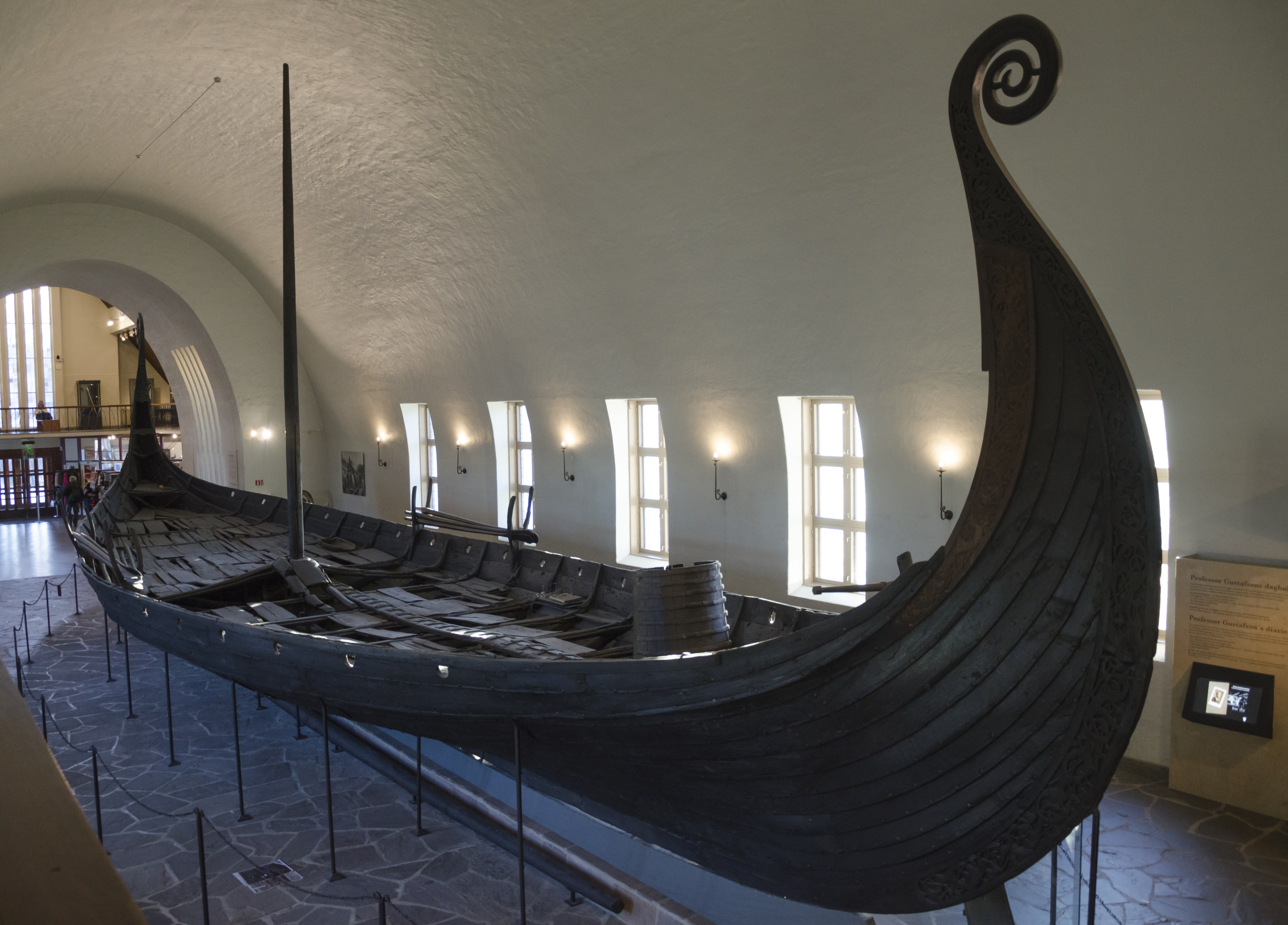
Oseberg ship (Wikimedia Commons)

It is possible that the Hogges was the site of a ship burial similar to that of the Oseberg or Gokstad sites in Norway, where a wealthy individual or family was interred on a ship laden with goods for the afterlife, and a mound raised around the remains. The treatment of human remains are a good indicator of religious practice in medieval northern Europe. Inhumations or burials without grave goods, especially in churchyards buried with their heads to the west and feet to the east, are generally Christian. Meanwhile the presence of grave goods, and cremation, are signs of a non-Christian burial; but this is how the people who buried the body chose to depose their dead, not necessarily what the living person believed.


A site of definite heathen interest lies between Hoggen Green and the Norse town: this space between where people lived in the west, and died in the east. This area was known as the Thingmotte in later medieval Dublin, the first half of which comes from the Norse term for a proto-parliament ‘thing’. This survives in other countries of Norse settlement in name, such as Iceland’s Þingvellir, Norway’s Gulatinget, Tingwall in the Orkneys, and Tynwald Hill in the Isle of Man. These are the areas that were specially used for administration and legal cases. 

In the absence of a state or overarching structure such as the Roman Church, self-imposed law assumed a religious component. Criminals did not just harm their victims and victims’ families, but society as a whole, and made restitution by returning to the ‘old’ and ‘proper’ ways of existence. Therefore the thing was held sacred throughout the Norse world as a site where gods and ancestors could receive proper deference by the establishment and resumption of an orderly society. The power of the thing continued after Christianisation but in a secular fashion, and even today several Nordic countries and territories use thing-related words for their parliamentary bodies. 

For centuries, confusion over the -motte ending which looks like ‘-mount’ led historians and amateurs alike to assume that the Hogges mound was the Thingmotte. But in a 2005 article Seán Duffy deftly identified that the Thingmotte was a distinct region ‘just outside the city’s eastern gate, straddling [modern] Dame Street, and lying to the west of Hoggen Green’ (358). Duffy explains that -motte is actually from the archaic English word moot, related to our modern English word ‘meeting’. The Thingmotte was still in use as a site of judicial administration by the time Henry II visited Dublin, which he used for his own law court in the winter of 1171-2. Its position just outside the town, but not within it, and linking the town to its burial ground, indicates the power and prestige of the Thing in Norse Dublin.

Another site of specific importance for heathenism in Dublin is a site mentioned in literary sources but whose location is not well-defined. This is Caill Tomair or the Wood of Thor, which I’ve reconstructed into Old Norse as *Þorsviðr

This grove appears several times in the Cogadh Gáedhel re Gallaib, which is a Munster text written in the first quarter of the twelfth century that purports to give the history of the Norse in Ireland culminating in the celebrated Battle of Clontarf. Brian Boru is the star of this text as it was composed for his great-grandson, Muirchertach Ua Briain; the overarching theme of the Cogadh is the prestige that Brian, and therefore his descendants, deserve for his subjugation of Norse and Gael alike. As a result, whether the historical Brian actually did so or not, the author of the text depicts him destroying sacred sites and royal symbols of his rivals all over Ireland. Therefore, when Brian’s forces capture Dublin in 1000, they make firewood out of Caill Tomair as part of the city’s subjugation. 

This was apparently such a massive undertaking that fourteen years later, when an attendant describes the Battle of Clontarf to the elderly Brian, he compares the noise and confusion to the sound and sight of chopping down Caill Tomair and setting it ablaze. Because of this, and the fact that presumably fourteen years wasn’t enough time for the grove to recover, it is unlikely that Caill Tomair was the same wood northeast of Dublin that trapped many of the Norse fleeing from Clontarf in the rising tide. In his 2014 book on Brian and the battle, Duffy suggests that Caill Tomair was near Dublin although well outside of the town, and may have been in the area of modern Phoenix Park (214-5). 


---------

Works Cited & Select Further Reading
Abrams, Lesley. 'The Conversion of the Scandinavians of Dublin.' In Anglo-Norman Studies, vol. 20, 1998, pp. 1-29.
Brady, Joseph, and Anngret Simms, eds. Dublin Through the Ages (c. 900--1900). Dublin, Four Courts Press, 2001.
Bradley, J., A. J. Fletcher, and A. Simms, eds., Dublin in the Medieval World. Four Courts Press, Dublin, 2009.
Clarke, Howard B., and Ruth Johnson, eds. The Vikings in Ireland and Beyond. Four Courts Press, Dublin, 2015.
Downham, Clare. ‘Religious and Cultural Boundaries between Vikings and Irish: The Evidence of Conversion.’ In Ní Ghrádaigh, Jenifer, and Emmett O’Byrne, eds., The March in the Islands of the Medieval West, Brill, 2012.
Duffy, Seán, Brian Boru and the Battle of Clontarf. Dublin, Gill & Macmillan, 2014.
Duffy, Seán, 'A reconsideration of the site of Dublin's Thing-mót.' Condit, Tom, and Christiaan Corlett, eds., Above and Beyond: Essays in Memory of Leo Swan, Wordwell, 2005, pp. 351-60.
Holm, Poul. ‘The naval power of Norse Dublin.’ In Purcell, Emer, et alia, eds., Clerics, Vikings, and High-Kings. Four Courts Press, Dublin, 2015, pp. 67-78.
Price, Neil. The Viking Way: Religion and War in Late Iron Age Scandinavia. Uppsala, Department of Archaeology and Ancient History, Uppsala University, 2002.  
Todd, James Henthorn, ed. and trans. Cogadh Gaedhel re Gallaibh: The War of the Gaedhil with the Gaill, or, The Invasions of Ireland by the Danes and Other Norsemen. Longmans, Green, Reader, and Dyer, London, 1867.
Valante, Mary. The Vikings in Ireland: settlement, trade and urbanization. Four Courts Press, Dublin, 2008.